
- About Us
-
Departments
Departments
- Admission
-
Int'l Cooperation
Int'l Cooperation
-
Research
Research
- Research at Ajou
- Ajou R&D Center
- faculty
- Applied Bio Technology
- Applied Sociology
- Architectural Engineering
- Architecture
- Biological Science
- Business Administration
- Business Analytics
- Chemical Engineering
- Chemistry
- Civil and System Engineering
- Civil and Transportation Engineering
- Computer Engineering
- Dependable Software
- Economics
- Education
- Electrical and Computer Engineering
- Energy Systems Research
- English Language and Literature
- Environmental Engineering
- Financial Engineering
- Global Management
- History
- Industrial Engineering
- Intelligence Semiconductor Engineering
- Korean Language and Literature
- Law
- Management Information Systems(MIS)
- Materials Science Engineering
- Mathematics
- Mechanical Engineering
- Media
- Medical Sciences
- Molecular Science and Technology
- NCW Engineering
- Nursing Science
- Pharmacy
- Physics
- Political Science and Diplomacy
- Psychology
- Public Administration
- Space Survey Information Technology
- Systems Engineering
- Library
- Research Sites
- Universities Sites
- Academics
- Board
-
4th BK21
4th BK21
Board
Notices
Request for Proposals: Global R&D Challenge Program
- 2026-05-07
- 66
Request for Proposals: Global R&D Challenge Program
The Korea Institute of Human Resources Development in Science and Technology (KIRD) hereby invites applications for research teams for the 2026 Global R&D Challenge Program in order to promote the settlement of young foreign scientists and engineers in Korea.
May 1, 2026
Bae Taemin, President of KIRD
1. Program Purpose
ㅇ Providing international STEM researchers with the opportunity to lead mock research projects to foster a deeper understanding of Korea's R&D environment and create meaningful incentives for long-term domestic settlement.
2. Program Details
A. Research Topic
Category | Key Details |
Project Type | ① Participation in Research Projects & Human Resource Exchange (Hosting overseas researchers in Korea, dispatching participating researchers abroad, etc.) ② Invitational/Visiting Research (Reciprocal on-site visits by Principal Investigators) ③ Utilization of Research Facilities & Equipment (Joint use of domestic/overseas research facilities and equipment) ④ Global Network Building (Hosting international conferences or workshops in Korea/overseas) |
ㅇ A bilateral cooperation-base project jointly involving two countries.
※ Research teams may select one program from the [Attachment] list of Foundation Building Projects for International Cooperation, then choose the specific project type(s) they wish to simulate (multiple selections allowed) to complete the application form.
※ Selection of target countries not included in the list is permitted(e.g. Korea-Pakistan Cooperation Base Program) ; however, multilateral collaborative research involving three or more countries is excluded from eligibility.
B. Number of Teams to Be Selected: Approximately 6 teams in total (each team consists of 4 research members and 1 faculty advisor)
※ No more than three teams from the same university may be selected.
C. Eligibility
ㅇ Research Team (4 members per team)
- Principal Investigator (1 person): A foreign graduate student in science or engineering at a Korean university, or a post-master’s / postdoctoral researcher within two years of graduation
※ Restrictions: Students on leave of absence, employed individuals, undergraduate students, and Korean nationals are not eligible to apply as a Principal Investigator.
※ Eligible Visa Types: D-2-3 (Master's Student), D-2-4 (Doctoral Student), F-2-7S (K-STAR / Post-Master's & Doctoral), F-2 (Resident; excluding F-2-99), F-4 (Overseas Korean), F-5 (Permanent Resident), F-6 (Marriage Immigrant)
- Co-Researchers (3 persons): Korean or foreign undergraduate students in science or engineering, graduate students in science or engineering, or post-master’s / postdoctoral researchers within two years of graduation
※ Students on leave, job seekers, and employed persons (subscribed to the four major social insurance programs) are not eligible to apply.
※ Up to two undergraduate students may be included.
※ Restrictions: Students on leave of absence and employed individuals are not eligible to apply.
※ Up to two undergraduate students may be included.
※ Eligible Visa Types: D-2-2 (Bachelor's Student), All visa types previously listed as eligible for the Principal Investigator
ㅇ Faculty Advisor (1 person per team): An assistant professor or above affiliated with a science or engineering department at a four-year university in Korea
※ Must provide research guidance and consultation at least twice per month, as well as research environment support, etc.
D. Support Provided
ㅇ Training: Education on the national R&D system and on writing research proposals
ㅇ Mentoring: Guidance on proposal writing from Korean researchers with experience in related research
ㅇ Research Funding: Up to KRW 10.5 million per team (for 4 months)
- Research Stipend: KRW 6.4 million (KRW 400,000 per month per person)
- Faculty Advisor Consulting Fee: KRW 1.6 million
- Indirect Costs: KRW 525,000
※ To be absorbed by the Industry-Academic Cooperation Foundation of the principal investigator’s university.
- Accounting Fee: KRW 220,000
※ Research expense settlement will be conducted by an accounting firm designated by KIRD.
- Research Activity Expenses: KRW 1.975 million
※ Includes research equipment and materials, expert utilization fees, meeting expenses, travel expenses, etc.
Category | Implementation Stage | Details | Responsible Party | Schedule | |
Program Management | Selection of Research Teams | Selection evaluation (document review and presentation evaluation) | KIRD/ Research Team/ | Document Review: 2nd week of June Presentation: 3rd week of June | |
Agreement | Agreement execution and disbursement of research funds | KIRD/ Industry-Academic Cooperation Foundation | End of June | ||
Settlement of Research Funds | Organize research expense records and detailed expenditure statements | Research Team / Industry-Academic Cooperation Foundation | October–November | ||
Team Project | Training | E-learning | Understanding Korea’s Science and Technology Policy and Processes | KIRD/ Research Team / Mentor | 7.01~7.31 |
1st Session | ‣Program Orientation & Participant Networking ‣ Understanding the National R&D System | 7.13~7.14 | |||
2nd Session | ‣ In-depth Understanding of Target Projects ‣ Hands-on Workshop: Writing Research Proposals | 8.18~8.19 | |||
3rd Session | ‣ Mid-term Evaluation of Research Proposal Drafts ‣ Know-how for PPT Design & Presentation Skills | 9.28~9.29 | |||
Mentoring | ‣ Expert Advisory Support for Each Research Team ‣ Conducting 3+ Mentoring Sessions | 7.01~9.30 | |||
Performance Presentation | Activity Report | ‣ Team Project Execution & Monthly Progress Reports ※ Submission deadline: Last day of each month | Research Team | Monthly, at month-end (Jul–Oct) | |
Mid-term Evaluation | ‣ Submission of Mock Research Proposal Drafts ※ Peer review session during in-person training | In September | |||
Final Evaluation | ‣ Submission of each team’s final mock research proposal | In October | |||
Submission of Research Poster | ‣ Submission and presentation of a poster based on final outcomes | December | |||
E. Final Deliverables
ㅇ Each team must submit a mock research proposal, presentation materials, and a poster through the team project.
※ Deliverables should include experimental plans, data collection, the need for international collaboration, proposed solutions, etc.
3. Selection of research team
A. Evaluation Procedure
ㅇ Submitted program applications will first undergo document review, followed by presentation evaluation.
① Preliminary Review | ② Expert Evaluation | ③ Announcement of Selected Teams | ||
Review of Program Application |
| 1st Round: Document Review 2nd Round: Presentation Evaluation |
| Announcement of Evaluation Results |


※ Teams advancing to the second-stage presentation evaluation (approximately twice the final selection quota) will be selected through the first-stage document review and notified separately.
【Preliminary Review】
ㅇ Review of eligibility, application format, missing documents, duplicate applications, etc. for each applicant team
【Expert Evaluation】
ㅇ (Evaluation Committee) Approximately five experts from industry, academia, and research institutes in relevant fields
※ To ensure objectivity and fairness, experts with conflicts of interest or concerns regarding impartial evaluation will be excluded.
ㅇ (Evaluation Criteria) Team composition, research plan, understanding of international collaboration, etc.
Evaluation Item | Detailed Indicator | Points |
Research Team Composition (40) | Expertise and R&D capacity of the principal investigator | 8 |
Commitment of domestic and international researchers (teams) to participate in the program | 20 | |
Nationality Diversity of Team Members (Single nationality: 3 pts; 2 nationalities with 3+ members from one country: 6 pts; 2 nationalities with 2 or fewer members per country: 9 pts; 3 or more nationalities: 12 pts) | 12 | |
Research Plan and Understanding of International Collaboration (60) | Excellence and creativity of the research objectives and contents | 20 |
Rationality and completeness of the project implementation system and strategy | 20 | |
Necessity of international collaborative research and specificity of the plan | 20 | |
Total | 100 | |
【Announcement of Selected Teams】
ㅇ Individual notification to principal investigators (document review pass: 2nd week of June → final presentation stage: 3rd week of June)
ㅇ Posted on the KIRD website (www.kird.re.kr → Notice Board → Announcements)
4. How to apply
A. Application Period and Required Documents
ㅇ Application Deadline: By 18:00 on Monday, June 1st, 2026
ㅇ Required Documents
① Application Form (HWP, Word, or PDF format, bearing the official seal of the Industry-Academic Cooperation Foundation)
② Presentation Materials (PPT or PDF format, 10-minute length, free format, no revisions after submission)
③ Certificate of Enrollment (for all 4 members; graduates must submit a certificate of graduation for their highest degree)
④ Copies of Passport and Alien Registration Card (ARC, front side) (for all foreign participants)
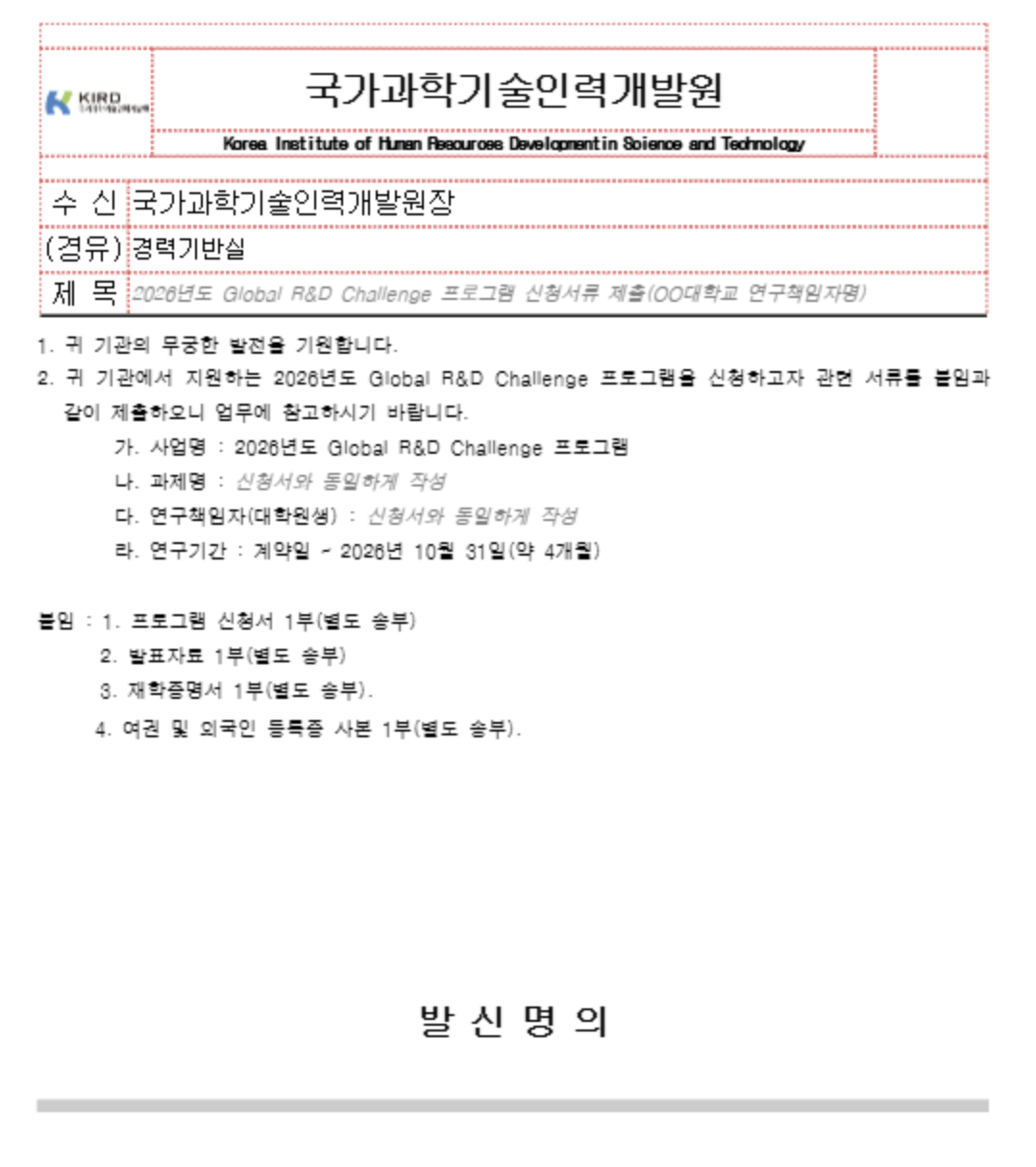
⑤ Official Cover Letter for Application (issued by the applicant university’s Industry-Academic Cooperation Foundation; see sample)
수신자 : 국가과학기술인력개발원장 (경유: 경력기반실) 제목 : 2026년도 Global R&D Challenge 프로그램 신청서류 제출(OO대학교 연구책임자명) | <official cover letter sample> |
1. 귀 기관의 무궁한 발전을 기원합니다. 2. 귀 기관에서 지원하는 2026년도 Global R&D Challenge 프로그램을 신청하고자 관련 서류를 붙임과 같이 제출하오니 업무에 참고하시기 바랍니다. 가. 사업명 : 2026년도 Global R&D Challenge 프로그램 나. 과제명 : 신청서와 동일하게 작성 다. 연구책임자(대학원생) : 신청서와 동일하게 작성 라. 연구기간 : 계약일 ~ 2026년 10월 31일(약 4개월) 붙임 : 1. 프로그램 신청서 1부(별도 송부) 4. 여권 및 외국인 등록증 사본 1부(별도 송부). 끝. |
|
B. Submission and Contact Information
ㅇ Submission: Online application (https://moaform.com/q/njFkfu)
ㅇ Contact: Bokyung Kim, Research Fellow(T. 042-820-4037 / bkkim@kird.re.kr)
Attachment | Reference Materials for Eligible Projects |
Region | Project Name | Description |
Americas | Collaboration with the U.S. Air Force Scientific Research Laboratory | Strengthening the international cooperation network with the United States and securing efficient and effective future core technologies |
Americas | Korea–U.S. Special Cooperation | Strengthening the science and technology cooperation system between Korea and the United States to improve and advance the level of national research and development, and expanding exchanges and strengthening networking between Korean and American scientists and engineers |
Americas | Korea–Canada (Quebec) Industry–Academia–Research Joint Research | Contribute to promoting domestic science and technology by strengthening the international cooperation network with Canada and securing future core technologies and cutting-edge technologies |
Asia | Korean Peninsula Science and Technology Cooperation | Establishing a foundation for cooperation between South and North Korea through research support for various cooperation tasks on the Korean Peninsula in the fields of science and technology and ICT and support for expert cooperation activities |
Asia | Korea–China Joint Research / Large-Scale Industry–Academia–Research Joint Research | Strengthen the scientific and technological competitiveness of both countries and expand the basis for mutual cooperation through joint research with China. Strengthen the scientific and technological competitiveness of both countries by supporting large-scale joint research between industry, academia and research institutes that is in high demand in both countries and creating visible research results. |
Asia | Korea–Japan Joint Research / Personnel Exchange | Strengthening the scientific and technological competitiveness of both countries and expanding the basis for cooperation by supporting joint research with Japan |
Asia | Korea–Mongolia Science and Technology Cooperation | Support for a general center to promote exchange and cooperation between Korea and Mongolia and support for joint research projects in each field that combine production and application technologies from Mongolia and Korea. |
Asia | Korea–Vietnam Cooperation Base Program | Strengthening the scientific and technological competitiveness of both countries and expanding mutual researcher cooperation networks |
Asia | Korea–Philippines Cooperation Base Program | To expand the basis for cooperation and strengthen scientific and technological capabilities by promoting joint research in the field of science and technology between researchers from both countries |
Asia | Expansion of Korea–India Science and Technology Cooperation | By supporting joint research between the two countries, we contribute to the promotion of mutually beneficial cooperation by combining basic scientific capabilities and human resources with Korea's commercialization experience. |
Asia | Korea–UAE Cooperation Base Program | Promoting joint research between Korean and UAE researchers to promote continuous exchange projects between Korea and the UAE and to foster Middle East experts |
Asia | Korea–Israel Cooperation Base Program | Promoting and strengthening cooperation in the science and technology field between the two countries through cooperative research between Korea and Israel in the field of cutting-edge technology, and revitalizing complementary cooperative research between the two countries and cooperative research between industry, academia, and research. |
Oceania | Korea–Australia Joint Research | Conduct joint research on areas of strength between the two countries and establish a Korea-Australia network |
Oceania | Korea–New Zealand Cooperation Base Program | Carrying out joint research on areas of strength between Korea and New Zealand and conducting research and building networks in the field of science and technology between Korea and Australia |
Europe | Korea–EU Joint Research Support Program | Domestic researchers responding to the EU's R&D common policy are encouraged to participate in EU joint research projects, thereby securing European source technologies and strengthening the research capabilities of domestic researchers. |
Europe | Korea–EU Cooperation Promotion Program | (Joint research) Promote Korea-EU research by supporting preparatory activities for participation of domestic researchers in Horizon Europe, a research and development project in Europe |
Europe | Korea–Germany Cooperation Base Program | (Joint research) Promotion of industry-academia or industry-research joint research, including industry, to commercialize research and development results and basic and source technologies (Manpower exchange) Training undergraduate students in the basic science field into the next generation of global talent through internship programs with excellent research institutes such as Max Planck, Jülich, and Helmholtz in Germany. |
Europe | Korea–Switzerland Cooperation Base Program | (Joint research) Promoting the development of scientific and technological cooperation by promoting joint research projects focusing on areas where synergy effects between Korea and Switzerland are expected. (Human resource exchange) Enhancing research outcomes and strengthening the international cooperation network through mutual research visits by new researchers (doctors and post-doctoral students) between Korea and Switzerland. |
Europe | Korea–UK Cooperation Base Program | (Joint research) Promoting scientific and technological cooperation between the two countries through international joint research, such as visiting and research exchanges between Korea and the UK (Human Resources Exchange) With the goal of revitalizing research exchange and cooperation, experts in fields of common interest in science and technology agreed upon by the two governments are selected as cooperation points (focal points) to hold workshops and seminars and support researcher exchange activities, etc. |
Europe | Korea–France Cooperation Base Program | (Joint Research) Promote scientific and technological cooperation between Korea and France by facilitating international joint research projects, including visiting research programs and academic exchanges. (Human Resource Exchange) Strengthen scientific networks and enhance research collaboration by supporting cooperative activities, such as joint seminars, workshops, and bilateral researcher exchange programs. |
Europe | Korea–Austria Cooperation Base Program | (Human Resources Exchange) Support human resource exchange and networking activities for research cooperation between Korea and Austria to provide opportunities to create a foundation for cooperation between the two countries. |
Europe | Korea–Luxembourg Joint Research Program | (Joint research) Promote scientific and technological cooperation between Korea and Luxembourg through international joint research, such as research visits and research exchanges between Korea and Luxembourg. |
Europe | Korea–Sweden Cooperation Base Program | (Joint research) Conduct joint research with Sweden focusing on science and technology to establish an excellent joint research system between researchers from both countries |
Europe | Korea–Norway Cooperation Base Program | (Joint research) Promote the development of scientific and technological cooperation by promoting joint research projects focusing on areas of cooperation between Korea and Norway. |
Europe | Korea–Finland Cooperation Base Program | (Joint research) Promote the development of scientific and technological cooperation by promoting joint research projects focusing on areas of cooperation between Korea and Finland. |
Europe | Korea–Spain Cooperation Base Program | (Human Resources Exchange) Strengthening the cooperation of domestic researchers with Spanish partners and establishing a bridgehead for cooperation and capacity building through human resource exchanges |
Europe | Korea–Italy Cooperation Base Program | (Joint research) Through support for joint research between Korea and Italy, we provide a venue for exchange of researchers in areas of common interest and expand cooperation between the two countries. |
Europe | Korea–Türkiye Cooperation Base Program | (Joint research) Promoting the development of scientific and technological cooperation between the two countries and discovering key scientific and technological fields through the promotion of Korea-Turkiye joint research projects |
Europe | Korea–Hungary Cooperation Base Program | (Joint research) Through joint research with Hungary, which has excellent basic research capabilities, the basic research capabilities of domestic researchers are improved and the cooperation network between researchers from both countries is strengthened. |
Europe | Korea–Czech Joint Research Program | (Joint research) Supporting international joint research and research exchange activities for research cooperation between Korea and the Czech Republic, providing opportunities to build a foundation for cooperation between the two countries |
※ Projects involving countries not listed above may also be proposed (e.g., Korea-Pakistan Cooperation Base Program). However, because the final research proposal must be submitted in two versions (one based on Korean criteria and one based on the criteria of the desired partner country), multilateral collaborative research projects involving multiple countries (e.g., Korea-V4 [Hungary, Czech Republic, Poland, Slovakia] cooperation-base projects) are excluded.